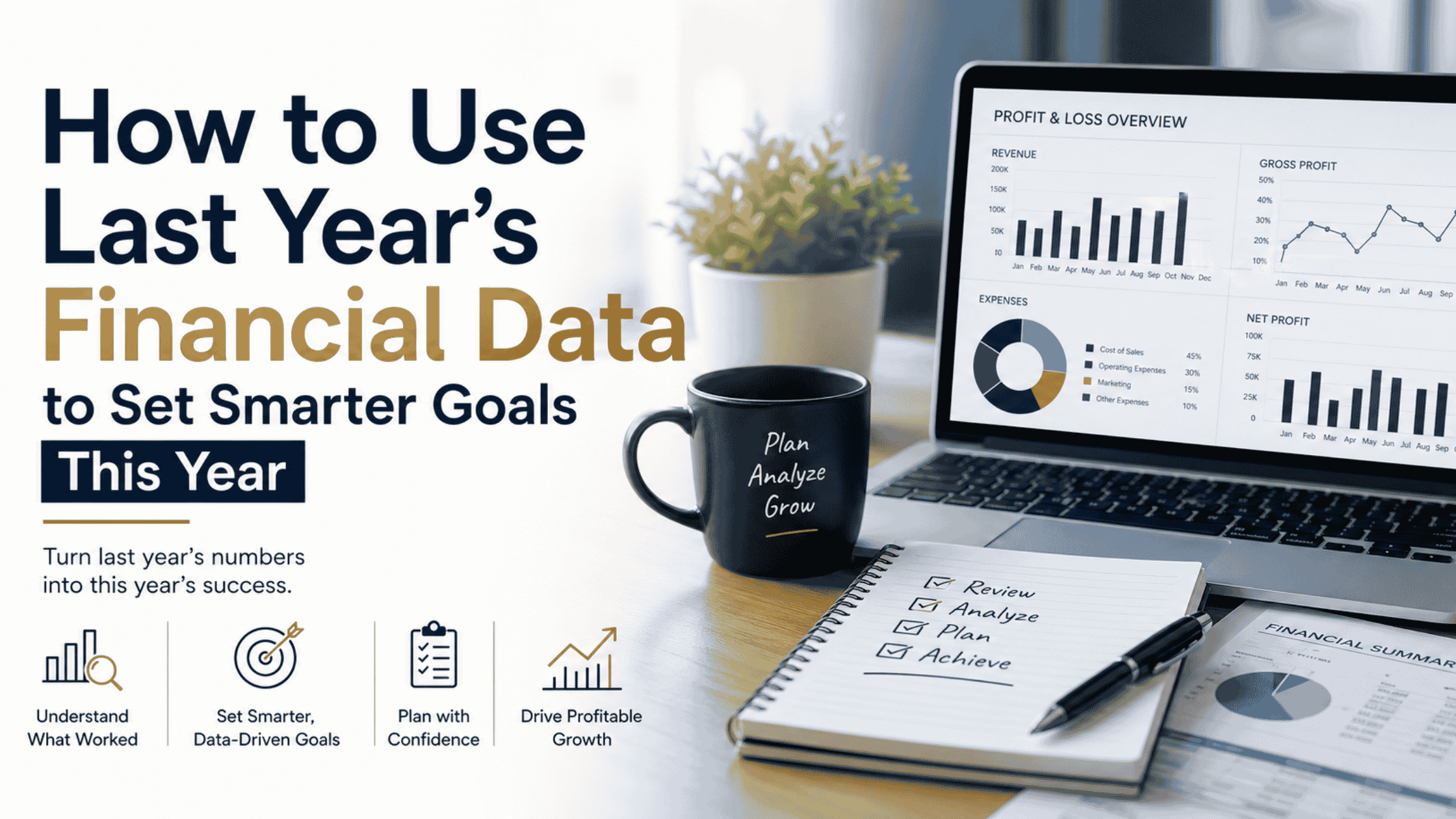
Introduction: The power of using real data instead of guesses
Every business owner has goals. Grow revenue. Increase profit. Reduce stress. Work smarter.
But here is the reality: goals built on assumptions tend to drift. Goals built on data tend to deliver.
Your most valuable planning asset is not a new spreadsheet or a trending strategy; it is already in your hands. Last year's financial data, especially your Profit and Loss statement, tells a story. Not just what happened, but why it happened.
When you take the time to interpret that story, you move from guesswork to precision. And that is where smarter, more achievable growth begins.
Revenue analysis: what grew, what shrank, and why
Start with the top line. Not just total revenue, but the composition of that revenue.
Which services or products performed best? Which ones underdelivered? More importantly, why?
Growth does not happen randomly. Maybe a specific service gained traction because of increased demand, better marketing, or stronger client relationships. On the other hand, a decline might point to pricing issues, reduced visibility, or operational inefficiencies.
This is where many businesses miss the opportunity. They see numbers, but they do not ask questions.
When you break revenue down by category, client type, or service line, patterns emerge. And those patterns give you clarity on where to double down and where to pivot.
Margin trends: your most important financial signal
Revenue is important. Profitability is critical.
Your margins tell you how efficiently your business is operating. They reveal whether growth is actually worth it.
If revenue increased but margins declined, you may be scaling inefficiently. Perhaps costs rose faster than income, or pricing did not keep pace with effort.
If margins improved, that is a strong signal that your systems, pricing, or client mix are aligned with profitability.
Tracking margin trends over time allows you to identify whether your business is becoming more sustainable or more strained. And that insight should directly inform your goals for the year ahead.
Client and service line profitability: the real picture
Not all revenue is created equal.
Some clients are easy to work with, pay on time, and generate strong margins. Others demand more time, create operational friction, and ultimately reduce profitability.
The same applies to your service lines.
When you evaluate profitability at this level, you often uncover surprising insights. A high-revenue service might actually be underperforming once costs are factored in. Meanwhile, a smaller offering could be your most efficient profit driver.
This is where strategic decisions are made.
- Do you refine your offerings?
- Adjust pricing?
- Focus on higher-value clients?
- Let go of unprofitable work?
Clarity here enables you to align your goals not just with growth, but with quality growth.
Expense patterns: where did money go that surprised you?
Expenses have a way of creeping in quietly. Subscriptions, operational costs, staffing inefficiencies, and small items compound over time.
Reviewing last year's expenses with intention often reveals areas that went unnoticed in real time.
- Were there costs that did not generate a clear return?
- Did certain categories increase without a strategic reason?
- Are there opportunities to streamline without sacrificing performance?
This is not about cutting for the sake of cutting. It is about ensuring every dollar spent is aligned with your business objectives.
When your expenses are intentional, your profitability becomes predictable.
Setting targets that are ambitious and grounded in reality
Once you have analyzed your data, goal-setting becomes far more strategic.
Instead of saying, "We want to grow by 20%," you can define how that growth will happen.
- Increasing revenue from your most profitable service line
- Improving pricing to protect margins
- Reducing unnecessary expenses
- Focusing on higher-value clients
These are not abstract goals. They are actionable, measurable, and rooted in real performance data.
Ambition is important. But ambition without structure leads to frustration. Data gives your ambition direction.
Building an accountability structure around your goals
A plan is only as strong as its execution.
Once your goals are set, the next step is building a system that keeps you accountable.
This includes:
- Monthly or quarterly financial reviews
- Clear KPIs tied to your goals
- Ownership of key initiatives within your team
- Regular check-ins to assess progress and adjust strategy
Consistency is what turns insight into results.
When you actively monitor your financial performance throughout the year, you are not reacting. You are leading.
Annual financial planning consultation
If you are ready to move beyond guesswork and build a strategy grounded in real financial insight, now is the time to act.
An annual financial planning consultation can help you uncover opportunities, identify risks, and set a clear path forward for the year ahead.
The data is already there. The opportunity is in how you use it.
Book Consultation